
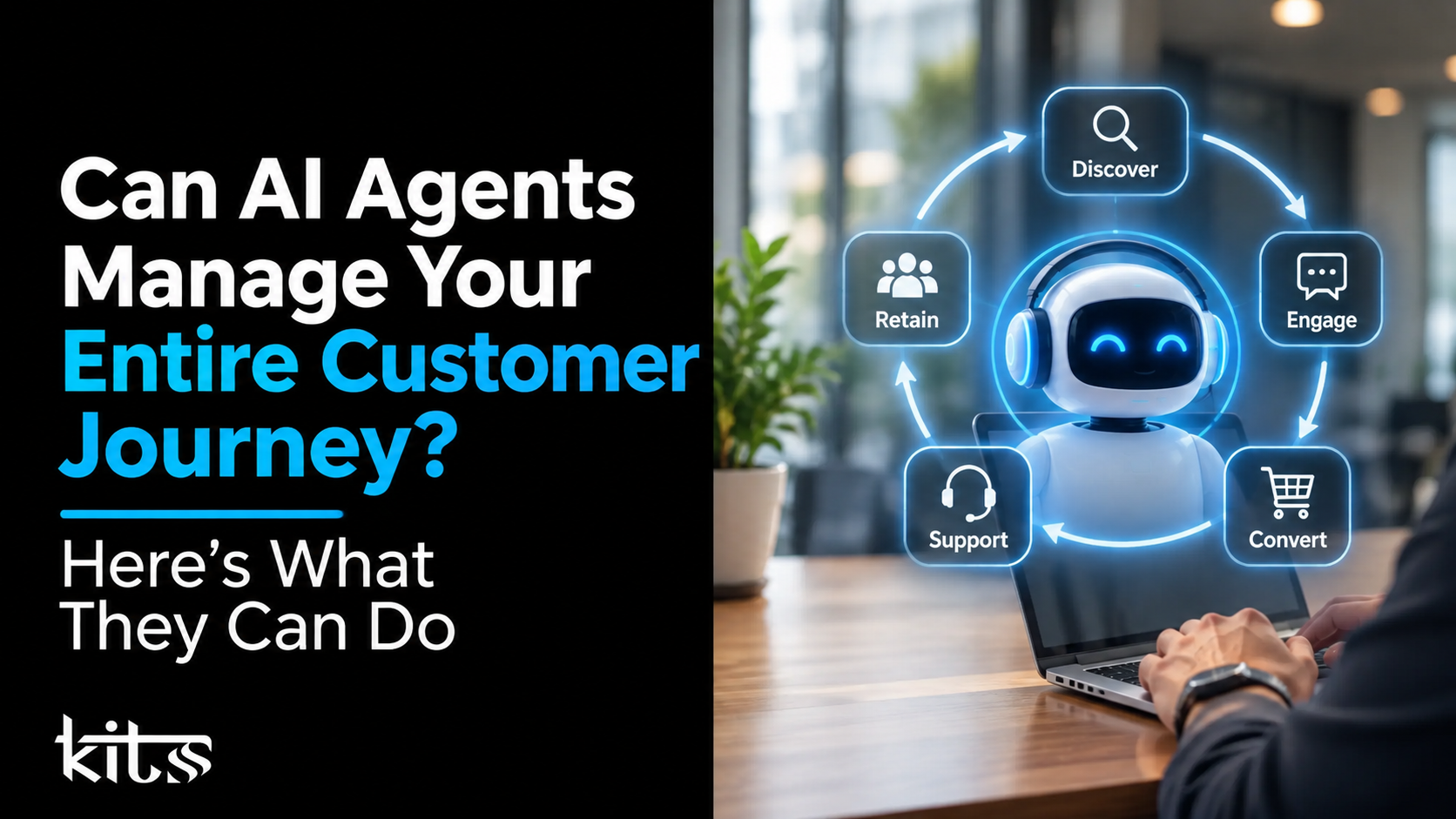
A customer journey rarely happens in one interaction. It starts when someone discovers your business, continues through enquiries and conversations, moves into purchasing decisions, and ideally leads to repeat business and long-term loyalty.
But managing every stage consistently can be challenging.
Businesses receive enquiries from multiple channels, sales teams struggle to follow up on time, customer questions go unanswered, and potential opportunities sometimes disappear simply because nobody took the next step.
This is where AI agents for business can make a significant difference.
Unlike traditional automation that follows predefined rules, AI agents can understand requests, interpret context, make decisions within defined boundaries, and take actions using connected business tools. They can help manage customer interactions, qualify leads, support sales teams, coordinate appointments, and improve post-purchase communication.
But can AI agents really manage your entire customer journey?
Let’s explore what they can do, where they deliver the most value, and how businesses can implement them effectively.
What Are AI Agents and How Do They Work?
AI agents are intelligent software systems designed to understand goals, process information, and perform tasks with a degree of autonomy. They use reasoning, planning, and connected tools to complete tasks and respond to different situations. Learn more in Google Cloud’s guide to AI agents.
They use AI models, business data, connected applications, and defined instructions to complete tasks that would otherwise require manual effort.
For example, imagine a potential customer visits your website and asks about your services.
An AI agent could:
- Understand the customer’s question.
- Identify which service they are interested in.
- Provide relevant information.
- Ask qualifying questions.
- Check available appointment slots.
- Book a consultation.
- Update the CRM with customer information.
- Trigger an appropriate follow-up.
Instead of simply responding to a message, the AI agent can help move the customer toward the next stage of the buying journey.
AI Agents vs Traditional Automation
Understanding the difference is important because not every automated workflow requires AI.
| Feature | Traditional Automation | AI Agents |
|---|---|---|
| Working method | Follows predefined rules | Interprets context and goals |
| Customer conversations | Usually scripted | Can handle more natural conversations |
| Decision-making | Based on fixed conditions | Can make bounded decisions |
| Adaptability | Limited to configured workflows | Can respond to different situations |
| Task execution | Performs scheduled or triggered actions | Can select and execute permitted actions |
| Complex requests | Often requires predefined paths | Can interpret requests and determine next steps |
| Human involvement | Depends on workflow design | Can escalate when needed |
Traditional automation remains useful for predictable, repetitive tasks. AI agents become particularly valuable when customer interactions involve different questions, changing circumstances, or multiple steps.
7 Ways AI Agents Can Manage Your Customer Journey
An effective customer journey involves several connected stages. AI agents can support each one by reducing delays, improving communication, and keeping business processes organised.
Let’s look at seven practical applications.
1. Attract and Engage Potential Customers
The customer journey often starts when someone discovers your business through Google, social media, paid advertising, referrals, or your website.
At this stage, potential customers may have questions but aren’t necessarily ready to speak with a salesperson.
If your business cannot respond quickly, that initial interest may disappear.
AI agents can help create a more responsive first interaction.
What AI agents can do:
- Respond to website enquiries.
- Answer common questions about products and services.
- Explain pricing information using approved business data.
- Collect basic customer requirements.
- Direct visitors towards relevant services.
- Identify high-intent enquiries for further assistance.
Example:
A visitor lands on a digital marketing agency’s website and asks whether the agency provides SEO services for e-commerce businesses.
An AI agent can understand the question, explain the relevant services, ask about the customer’s business requirements, and offer to arrange a consultation.
The visitor receives immediate assistance instead of waiting for someone from the sales team to become available.
2. Capture and Qualify Leads Automatically
Generating leads is only the beginning. Businesses also need to understand whether those leads are relevant, what they need, and how quickly they should be contacted.
AI agents can help collect and organise this information.
Instead of asking sales teams to manually review every enquiry, an AI agent can conduct an initial qualification conversation.
What AI agents can do:
- Collect names, email addresses, and phone numbers.
- Ask questions about customer requirements.
- Identify service interests and purchase intent.
- Capture budgets and project timelines when relevant.
- Categorise enquiries based on predefined qualification criteria.
- Send qualified leads to the appropriate sales representative.
Example:
A real estate agency receives enquiries about multiple properties.
An AI agent can ask prospective buyers about their preferred location, budget, property type, and buying timeline.
Based on the answers, it can organise the enquiry and help the sales team prioritise relevant prospects.
This makes lead management more structured and reduces unnecessary manual work.
3. Manage Follow-Ups and Lead Nurturing
One of the biggest problems businesses face is inconsistent follow-up.
A potential customer might enquire today, request additional information tomorrow, and make a purchasing decision several days later.
If nobody maintains communication during that period, the opportunity can easily be lost.
AI agents can help maintain relevant conversations throughout the decision-making process.
What AI agents can do:
- Send personalised follow-up messages.
- Respond to additional customer questions.
- Share relevant service information.
- Identify customers who need further assistance.
- Trigger email or SMS follow-up workflows.
- Update CRM records after interactions.
- Notify sales representatives when a lead shows buying interest.
Example:
A customer requests a quotation from a home service company but doesn’t confirm the booking.
An AI agent can follow up after an appropriate interval, ask whether the customer has any questions, and help them move towards scheduling the service.
If the customer raises a complex concern or requests a special discount, the conversation can be transferred to a human representative.
The goal isn’t to send more messages. It’s to make every follow-up more relevant and timely.
4. Schedule Appointments and Coordinate Bookings
Appointment management can consume considerable time, especially for businesses handling multiple enquiries every day.
Customers may ask about availability, request alternative timings, cancel appointments, or need reminders before their scheduled visits.
AI agents can assist with these activities through connected scheduling systems.
What AI agents can do:
- Check available appointment slots.
- Suggest suitable booking times.
- Schedule consultations and service appointments.
- Send booking confirmations.
- Manage permitted rescheduling and cancellation requests.
- Send appointment reminders.
- Update the CRM with booking information.
Example:
A fitness studio receives a website enquiry from someone interested in personal training.
The AI agent can explain the available training options, ask about the customer’s preferred schedule, check appointment availability, and arrange an introductory session.
The customer doesn’t have to wait for a staff member to respond during business hours.
5. Improve Customer Support and Problem Resolution
Customer support doesn’t end after a purchase.
Customers may need product information, order updates, troubleshooting assistance, billing clarification, or help using a service.
AI agents can provide support by accessing approved knowledge bases and connected systems. They can also help resolve routine customer enquiries, retrieve relevant information, and support customer service teams. Explore IBM’s guide to AI agents in customer service
What AI agents can do:
- Answer frequently asked questions.
- Provide product or service information.
- Retrieve relevant customer details.
- Check order or service status through connected systems.
- Guide customers through basic troubleshooting.
- Create support tickets.
- Escalate complex or sensitive requests to human teams.
Example:
An e-commerce customer asks about the status of an order.
An AI agent connected to the order management system can retrieve the available order information and provide an update.
If the order information is unavailable or the customer reports a serious issue, the agent can create a support ticket and route the request to the appropriate team.
This helps customers get faster answers while allowing support representatives to focus on more complicated issues.
6. Automate Post-Purchase Communication and Customer Retention
Many businesses concentrate heavily on acquiring new customers but overlook the importance of retaining existing ones.
However, the customer journey continues after the transaction.
Customers may need onboarding assistance, product guidance, service reminders, renewal notifications, or personalised recommendations.
AI agents can help businesses maintain communication after a purchase.
What AI agents can do:
- Send onboarding instructions.
- Answer post-purchase questions.
- Share relevant product or service recommendations.
- Identify customers who may need additional assistance.
- Send renewal and subscription reminders.
- Collect customer feedback.
- Trigger retention workflows based on customer activity.
Example:
A software company signs up a new customer.
An AI agent can guide the customer through the initial onboarding process, answer questions about basic features, share relevant resources, and notify the customer success team if additional assistance is required.
This creates a more organised customer experience beyond the initial sale.
7. Re-Engage Inactive Customers and Identify New Opportunities
Not every customer purchases immediately, and not every existing customer remains active.
Some prospects stop responding, while previous customers may not return for another purchase.
AI agents can help businesses identify these opportunities through CRM data and customer activity.
What AI agents can do:
- Identify inactive leads.
- Find customers who haven’t purchased recently.
- Send relevant re-engagement messages.
- Ask customers whether their requirements have changed.
- Identify potential upselling opportunities.
- Notify sales teams about customers showing renewed interest.
Example:
A home renovation company has several old enquiries that never converted into projects.
An AI agent can identify eligible leads from the CRM, initiate an appropriate re-engagement conversation, and collect updated project requirements.
Interested customers can then be routed to the sales team for further discussion.
Re-engagement should always respect customer communication preferences and applicable consent requirements.
Where AI Agents Fit Into the Complete Customer Journey
The following table shows how AI agents can support customers from their first interaction to long-term retention.
| Customer journey stage | AI agent activity | Business benefit |
|---|---|---|
| Awareness | Answers initial questions | Faster customer engagement |
| Enquiry | Collects customer information | Better lead capture |
| Qualification | Evaluates requirements | More organised sales pipeline |
| Consideration | Shares relevant information | Better-informed prospects |
| Conversion | Supports bookings and sales handoffs | Reduced manual coordination |
| Onboarding | Provides guidance and instructions | Smoother customer experience |
| Support | Handles routine questions | More responsive customer service |
| Retention | Sends relevant reminders and updates | Stronger customer relationships |
| Re-engagement | Contacts eligible inactive leads | Additional sales opportunities |
The biggest advantage is that these activities don’t have to operate independently.
When AI agents are connected to your CRM and other business applications, customer information can move between different stages without requiring employees to repeatedly enter the same details.
What Tools Do AI Agents Need to Manage Customer Journeys?
AI agents become more useful when they can interact with the systems your business already uses.
Without integrations, an AI agent may only be able to answer questions. With appropriate permissions and connections, it can also perform business tasks.
Here are some important components of an AI-powered customer journey system.
| Technology | Purpose |
|---|---|
| AI models | Understand customer requests and generate responses |
| CRM software | Store customer information and interaction history |
| Workflow automation | Trigger actions based on events and conditions |
| Email and SMS platforms | Manage customer communication |
| Appointment scheduling tools | Coordinate bookings and availability |
| Knowledge bases | Provide accurate business and service information |
| Analytics and reporting | Track customer activity and performance |
| Integration platforms | Connect different business applications |
Why CRM Integration Is Important
A CRM acts as a central source of customer information.
When AI agents are connected to a CRM, they can access relevant customer records, update information, record conversations, and trigger appropriate workflows.
For example, a business using GoHighLevel can combine CRM records, conversations, appointment scheduling, and workflow automation to create a more connected customer management process.
With the right configuration, an AI agent can:
- Capture a new enquiry.
- Create or update the contact record.
- Assign the appropriate lead category.
- Trigger a relevant workflow.
- Arrange an appointment.
- Record interaction details.
- Notify the responsible team.
This is where AI CRM integration becomes valuable: it connects customer conversations with actual business operations.
AI Agents vs Traditional CRM Automation: Which Should Your Business Choose?
AI agents and traditional CRM automation aren’t competing technologies. In many cases, the best solution combines both.
Traditional automation is ideal for predictable activities, while AI agents are useful for interactions that require contextual understanding.
Consider the following examples:
| Business task | Recommended approach |
|---|---|
| Send a booking confirmation | Traditional automation |
| Answer an unexpected customer question | AI agent |
| Update a CRM field after a form submission | Traditional automation |
| Qualify a lead through conversation | AI agent |
| Send a scheduled renewal reminder | Traditional automation |
| Understand why a customer wants to cancel | AI agent with human escalation |
| Assign leads using fixed criteria | Traditional automation |
| Handle complex multi-step customer requests | AI agent with defined permissions |
The most effective approach is to use AI where interpretation and decision-making are needed, and conventional automation where consistency and predictable execution matter most.
Can AI Agents Completely Replace Human Employees?
No. AI agents can handle many repetitive interactions and operational tasks, but they shouldn’t replace human judgement in every situation.
Some customer interactions require empathy, negotiation, professional expertise, or an understanding of circumstances that an automated system may not fully recognise.
For example:
- A frustrated customer may need a human support representative.
- A high-value sales opportunity may require personal negotiation.
- A healthcare enquiry may require qualified clinical judgement.
- A complicated refund or billing dispute may need manual review.
- A sensitive customer complaint may require management involvement.
Businesses should establish clear boundaries around what AI agents can access, decide, and execute. Responsible AI implementation also requires appropriate risk assessment, human oversight, and continuous monitoring. Refer to the NIST AI Risk Management Framework for guidance.
A good implementation should include:
- Human escalation options.
- Approved information sources.
- Defined action permissions.
- Customer data protection controls.
- Conversation monitoring.
- Testing and performance reviews.
The objective is not to remove people from the customer journey. It is to allow employees to focus on interactions where human involvement creates the most value.
How to Implement AI Agents Across Your Customer Journey
Introducing AI agents doesn’t mean automating every business process at once.
A phased approach makes implementation easier to manage and evaluate.
Step 1: Map Your Existing Customer Journey
Identify how customers currently discover your business, submit enquiries, receive follow-ups, make purchases, and access support.
Look for delays, repetitive activities, missed opportunities, and communication gaps.
Step 2: Identify Processes Suitable for AI
Not every task needs an AI agent.
Start with processes involving frequent customer interactions, repetitive questions, lead qualification, or information gathering.
Step 3: Connect Your CRM and Business Applications
Identify which systems AI agents need to access.
These may include your CRM, website chat, email platform, appointment scheduler, payment system, and customer support software.
Step 4: Define AI Agent Roles and Permissions
Give each agent a clear purpose.
For example, a lead qualification agent should focus on collecting customer requirements, while a customer support agent should focus on resolving approved support requests.
Define which actions require human approval.
Step 5: Build Automated Workflows
Connect AI agent activities with your existing business processes.
For example, when an AI agent qualifies a lead, it can update the CRM, trigger a follow-up workflow, and notify the appropriate sales representative.
Step 6: Test Real Customer Scenarios
Test different conversations, unexpected questions, incomplete information, and situations requiring human intervention.
Make sure the agent doesn’t invent information or perform unauthorised actions.
Step 7: Monitor and Improve Performance
Track response quality, lead qualification, booking completion, escalation rates, customer satisfaction, and conversion performance.
Use these insights to improve instructions, integrations, and workflows over time.
Key Metrics to Measure AI Customer Journey Performance
Implementing AI agents is only valuable when it improves measurable business outcomes.
Businesses should monitor the following metrics:
| KPI | What it measures |
|---|---|
| First response time | How quickly customers receive an initial response |
| Lead qualification rate | Percentage of enquiries meeting qualification criteria |
| Appointment booking rate | Percentage of relevant enquiries that become bookings |
| Lead-to-customer conversion rate | Percentage of leads converted into customers |
| Follow-up completion rate | Whether planned follow-ups are completed |
| Customer satisfaction | How customers evaluate their experience |
| Support resolution time | Time required to resolve customer issues |
| Customer retention rate | Percentage of customers retained over a period |
Compare performance before and after implementation. This helps identify whether AI agents are genuinely improving operations rather than simply increasing automation activity.
The Future of Customer Journey Management Is Connected and Intelligent
Customer expectations are changing.
People want quick responses, relevant recommendations, convenient bookings, and consistent communication across different channels.
Businesses that rely entirely on manual processes may struggle to maintain this level of responsiveness as enquiry volumes increase.
AI agents offer an opportunity to connect customer interactions with business operations.
From capturing the first enquiry to managing follow-ups, scheduling appointments, supporting customers, and identifying retention opportunities, AI agents can contribute to almost every stage of the customer journey.
However, success depends on more than choosing an AI tool. It requires the right CRM, integrations, workflows, business information, and human oversight.
How KITSS Helps Businesses Build Smarter AI-Powered Customer Journeys
At KITSS, we help businesses bring their customer management, CRM systems, and automation processes together.
Our approach focuses on identifying operational gaps and implementing practical technology solutions that help businesses manage customer interactions more efficiently.
Our services include:
- AI Agents & Automation: Build AI-powered solutions to manage customer conversations and business tasks.
- AI Voice Agents: Handle incoming calls, answer common questions, qualify enquiries, and support appointment booking.
- CRM Implementation & Integration: Connect platforms such as GoHighLevel, Zoho, and Salesforce with your business operations.
- Marketing Automation: Build automated email, SMS, and lead-nurturing workflows.
- Business Process Automation: Reduce repetitive administrative work through connected systems and intelligent workflows.
- Custom Integrations: Connect your existing applications to create a more unified business environment.
Whether you want to improve lead management, automate customer communication, or build a connected AI-powered sales process, the right implementation can help your business work smarter.
Ready to make your customer journey smarter?
Let’s identify where AI agents and automation can make the biggest difference in your business.
Book a Free Consultation with KITSS and explore the right AI automation strategy for your business.