
How to Run a Commercial Laundry Business on Autopilot with Agentic AI
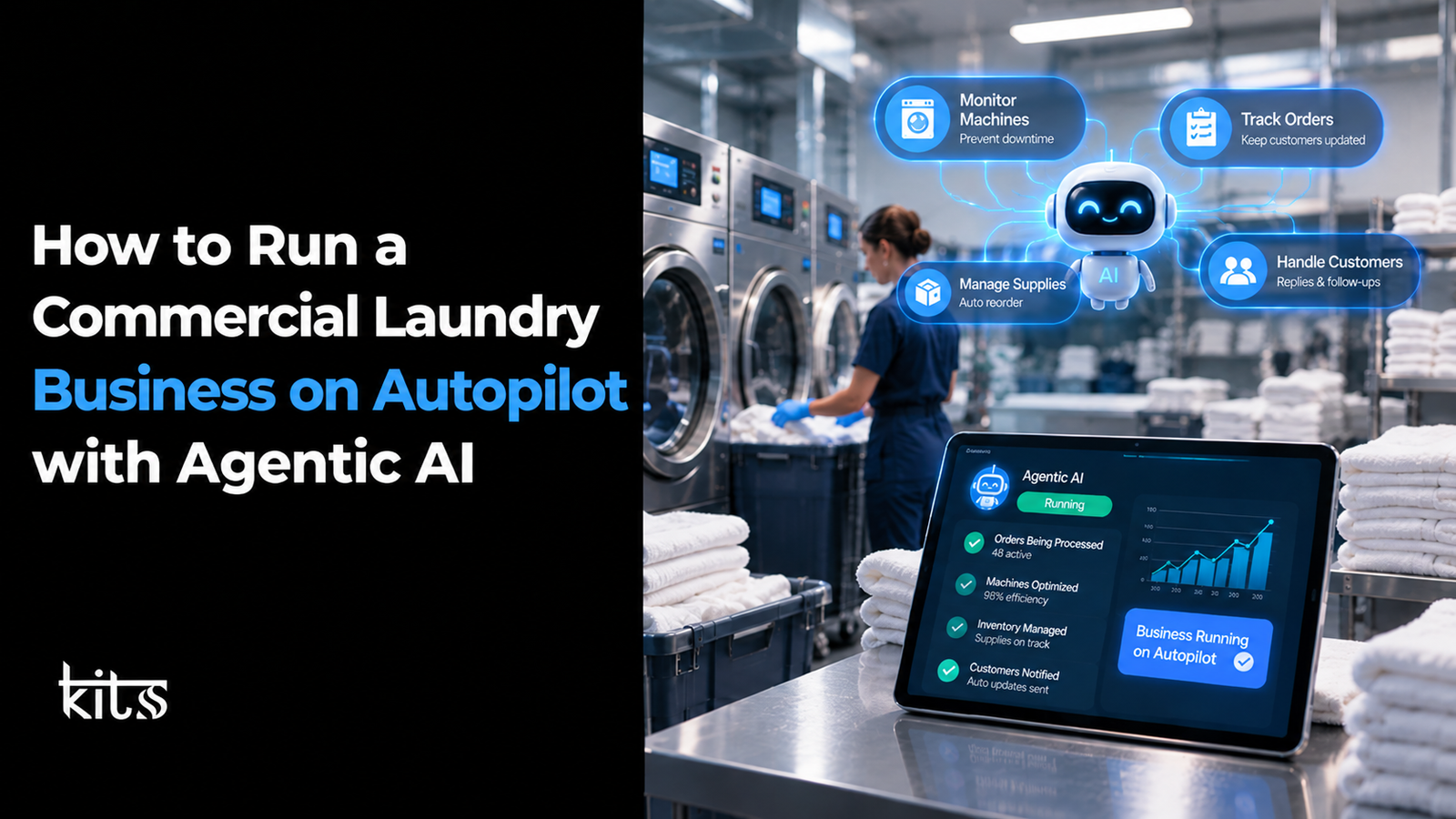
Your laundry business is growing fast, but daily operations feel just as manual as ever. You start your morning juggling urgent requests from hotels, delivery updates, rescheduling pickups, and new quotes all before breakfast.
Yesterday’s invoices still need sending, customers haven’t confirmed their next orders, and your team is spread thin coordinating collections across dozens of locations. It’s enough to make anyone wonder: why isn’t more of this running on autopilot?
Honestly, running a commercial laundry business means wrangling a lot more than just washing and folding. You’ve got bookings, customer questions, recurring orders, staff schedules, deliveries, billing, and ongoing communication. As your customer base grows, so does the mountain of admin work.
You might have all the machines and staff you need, but you still find yourself stuck chasing routine details.
Here’s the question: what if your business could handle more of this automatically, without you overseeing every last detail?
With smart CRM tools, connected business software, automation, and agentic AI, you can set up your laundry operation to handle routine work on its own.
Let’s break down how to automate your customer journey, manage those high-volume accounts, cut out admin choke points, and use AI agents to streamline everything keeping your team in charge where it matters.
Why Scaling a Commercial Laundry Business Is Hard
Growth always sounds simple- more customers, more laundry, more revenue. But every new account brings its own quirks. Hotels want daily linen collections. Apartment managers need coordination between guest check-ins. Residential customers expect weekly pickups.
The tricky part isn’t the laundry itself it’s everything else surrounding it.
1. Missed Calls Cost You Business
People call for all sorts of reasons maybe they’re asking for a quote, trying to arrange a collection, changing delivery times, or just checking if you can help them out.
If your team isn’t picking up, those customers won’t wait around. They’ll reach out to someone else, and you lose their business. Even your regulars can get annoyed when they can’t get through.
An AI voice assistant can step in here answering basic questions, grabbing customer details, recording service requests, or sending urgent calls straight to the right person.
2. Manual Scheduling Is a Recipe for Chaos
Keeping track of hotel linen pickups, restaurant laundry schedules, or residential requests using calls, texts, and spreadsheets gets messy fast, especially as things ramp up.
With automation, you can handle confirmations, reminders, and change notifications without breaking a sweat.
If you plug it into your scheduling or laundry system, your staff can always see what’s going on and nothing slips through the cracks.
3. Customers Always Want Order Updates
Everyone wants to know where their laundry is when’s it getting picked up or delivered, how long will it take, is it on the way?
If you’re not letting them know proactively, your staff winds up fielding the same questions over and over. That’s just wasted time.
Automated updates by email, SMS, or WhatsApp keep customers in the loop at every key stage, assuming your order status is hooked up to the system.
4. Quotes and Invoices Need Real Follow-Up
Sending out a quote or invoice isn’t enough. Someone needs to stay on top of it, answer questions, and nudge things along. If reminders slip, payments get delayed and cash flow turns shaky.
A CRM combined with automation can handle follow-ups, payment reminders, and alert your team when it’s time to step in personally. It keeps everything moving and your revenue steady.
What Does It Mean to Run a Laundry Business on Autopilot?
“Autopilot” doesn’t mean kicking people out of the business. It just means cutting down the manual grunt work, especially for the routine stuff.
Think about all those repetitive things, like remembering to follow up with customers, send booking confirmations, or chase payments. With the right systems, you can let software take care of those jobs automatically, so nothing falls through the cracks.
Here’s how this might look:
- A new customer inquiry pops up in your CRM.
- The customer gets a welcome message and clear next steps.
- The system automatically schedules a follow-up about the quote.
- Recurring customers get timely reminders before collections.
- Customers hear about changes to their orders without having to ask.
- Overdue invoices set off reminders no one needs to check dates on a calendar.
- Your team only gets pulled in when there’s an unusual problem or a decision that needs a human touch.
Traditional automation works by following set rules. Agentic AI takes it further it actually “understands” requests, figures out what needs to get done, and picks from allowed actions based on what it knows.
For example, if a customer messages in to change a pickup, an AI agent could check the booking, see what change is needed, confirm availability, and if it has permission update the booking or flag a team member if a person needs to step in.
Autopilot isn’t about replacing every job with automation. It’s about smoothing out routine work but making sure people still drive important choices.
7 Ways Agentic AI Makes Life Easier for Commercial Laundry Operations
|
Workflow |
What can be automated? |
Where human oversight matters |
|---|---|---|
|
Lead management |
Capture details and assign enquiries |
Complex quotes and contracts |
|
Scheduling |
Send reminders and process permitted changes |
Capacity and urgent delivery decisions |
|
Customer communication |
Send approved notifications |
Complaints and unusual requests |
|
Billing |
Send invoice reminders |
Disputes and financial adjustments |
|
Customer retention |
Schedule check-ins and flag inactive accounts |
Relationship management |
1. Capturing and Qualifying New Customer Inquiries
Commercial laundry businesses hear from all sorts of places hotels, restaurants, clinics, gyms, you name it. Answering every message by hand slows you down and risks missed leads.
With an AI-powered system, you can:
- Reply instantly to website inquiries
Handle common questions about your services or how things work - Collect the info you actually need to give a real response
- Spot what kind of business is asking and figure out their likely order sizes
- Log it all in the CRM
- Tell your sales team when someone needs a quote or a phone call
That means no more disorganized piles of sticky notes just a smooth path from “hello” to “deal.”
2. Managing Recurring Bookings and Collections
Hotels need laundry done every few days, restaurants maybe just on certain days. Automation steps in here by sending out timely reminders, confirming collections, and flagging anything irregular.
If you connect the system to proper scheduling software, AI can even handle changes within approved rules. No more manual reminders less stuff gets missed.
3. Sending Proactive Order and Delivery Updates
Customers shouldn’t have to chase you for updates. Automation can ping them whenever there’s a change:
- Confirming bookings
- Reminding them when you’re coming by
- Notifying them if the schedule shifts
- Sending delivery updates
- Telling them how to reach out if something’s off
But keep in mind, the main system data needs to be spot-on. If your info is wrong or outdated, no automation can fix that.
4. Keeping Accounts and Multiple Locations Organized
If you serve lots of different businesses hotels, restaurants, clinics you need a place for all those details: names, contacts, special needs, schedules, billing info.
A solid CRM keeps it all together:
- Who’s who
- What services they get
- Communication logs
- Milestones, quotes, contracts
Automation then keeps up with reminders and routine check-ins. And if you handle more than one location per client, all that information links up, so you know exactly who needs what, where, and when without digging through old emails.
5. Automating Invoicing and Payment Chasing
The job’s not over when the delivery’s done. You’ve got to invoice, track payments, and poke customers when they’re late.
With the right accounting setup, automation can:
- Generate invoices as soon as an order hits a milestone
- Send invoices out
- Remind customers about due dates
- Alert staff when payments are overdue
- Log responses and payment questions
- Flag disputed invoices for a person to review
Money rules stay in your hands automation just makes it less tedious and more transparent.
6. Boosting Customer Retention and Repeat Orders
New customers are great, but keeping them is even better.
You risk losing clients if you don’t keep in touch or catch changing needs. Automation helps you hold onto relationships by:
- Scheduling regular check-ins
- Reminding folks about repeat orders
- Following up after you’ve fixed a problem
- Asking for reviews at the right time
- Notifying you when a regular goes quiet
- Telling your team when somebody needs a hands-on touch
Agentic AI can even figure out the next right move, based on history and business rules. Your team then focuses on the tough cases.
7. Producing Daily Summaries
Running a laundry business often means checking multiple systems just to see what’s going on. You can set up a daily summary, showing:
- New leads
- Quotes waiting for a response
- Upcoming collections and deliveries
- Customer requests needing action
- Overdue invoices
- Complaints still open
- Today’s to-do items
If your systems are talking to each other, an AI agent can pull this info together and spotlight the most urgent stuff. Managers get a clear head-start for the day no manual digging required.
A Real-Life Example: Automating a Hotel Laundry Account
Picture this – a laundry company handling linens for hotels.
Without automation, staff spend loads of time recording inquiries, sending quotes, confirming schedules, sending status updates, hunting down payments. It’s easy to drop the ball.
A connected, automated workflow looks way different:
Step 1: Inquiry comes in
The hotel reaches out—maybe online or by phone. An AI agent grabs all the nuts and bolts: who, where, what, how much, preferred timing.
Step 2: Lead captured
Details go into the CRM. The right salesperson gets pinged.
Step 3: Automatic quote follow-up
When the quote goes out, the next follow-up is scheduled. If the hotel has questions or wants changes, the system records it and pings the team.
Step 4: Scheduling gets set
Deal’s done? The schedule drops into your operations system. Reminders go out right on cue.
Step 5: Automated customer updates
System pulls real order status and sends updates—no extra work needed.
Step 6: Invoice and payment reminders
Billing notifications go out on time, according to your rules.
Step 7: Ongoing account monitoring
CRM keeps up with every call, message, and update. Red flags like missed orders or changed habits pop up for the team to check.
End result: A smoother experience for the customer. Less busywork for the staff. Better insight for the business.
Obviously, how far you get with automation depends on the tools you’ve got laundry software, accounting, CRM, and all the rest.
What Software Does a Commercial Laundry Business Actually Need?
You don’t have to rip out all your old software to start automating. What you use depends on your size, how you work, and what you need.
It’s all about getting the systems you already rely on to share info in the right ways.
The main building blocks are:
1. CRM software: Tracks leads, contacts, account details, comms, and sales follow-ups.
2. Laundry management software: Takes care of orders, tracks items, production, routing, and anything laundry-specific.
3. Booking and scheduling tools: Handles collections, repeat bookings, delivery plans, appointments.
4. AI voice and messaging: Voice agents, chatbots, and automated emails/messages for questions, requests, and updates.
5. Billing and accounting software: Manages invoices, payment reminders, and financial records.
6. Integration and automation tools: Bridges gaps so info flows smoothly between all your systems.
7. Reporting and analytics: Dashboards for keeping an eye on leads, customer activity, late invoices, and more.
Ready to Automate? Start Simple
You don’t have to transform your entire business overnight. With the right approach, you can start with a few time-consuming tasks and gradually build a more connected, automated operation.
And you don’t have to do it all yourself. KITSS can help you identify what to automate, choose the right tools and put the workflows in place. Here’s how to get started.
Step 1: Identify Where You’re Losing Time
Start by looking at the tasks your team repeats every day.
Are you constantly answering calls about bookings? Manually confirming collections? Chasing quotations, updating customer records or following up on unpaid invoices?
Make a list of these tasks and identify which ones consume the most time, cause delays or frequently get missed.
KITSS can help you review these processes and prioritise the opportunities that make the most sense for your business.
Step 2: Automate the Simple, Repetitive Tasks First
You don’t need advanced AI for every task. Often, the biggest early wins come from automating straightforward activities such as:
Acknowledging new customer enquiries.
Sending booking confirmations and reminders.
Following up on quotations.
Sending routine payment reminders.
Scheduling customer check-ins.
These workflows reduce manual administration and help ensure routine tasks happen consistently.
Step 3: Connect Your Existing Software
If your team constantly switches between a CRM, messaging tools, spreadsheets, booking software and accounting systems, it may be time to connect them.
With the right integrations, information can flow between compatible platforms, reducing duplicate data entry and helping your team work from more consistent records.
KITSS can help assess your existing setup and identify practical ways to connect your customer management, communication and automation workflows without automatically replacing every system you already use.
Step 4: Introduce AI Agents Where They Add Value
Once your basic workflows are organised, consider where AI agents could take on more involved tasks.
For example, an AI voice agent could answer routine calls and record collection requests. An AI-powered workflow could interpret a customer message, retrieve relevant information and initiate an approved action.
KITSS can help you identify suitable use cases, define permissions and build workflows with appropriate human oversight.
Step 5: Bring Your Workflows Together and Measure the Results
The goal is not to accumulate more software. It is to create a connected system that makes daily business management easier.
Where supported, a central dashboard can give you visibility into enquiries, conversations, follow-ups and pending actions, while connected systems continue handling specialised operational tasks.
Track the results that matter:
Response times for new enquiries.
Unanswered calls.
Time spent on administration.
Quote conversion rates.
Collection and delivery reliability.
Overdue invoices.
Repeat business and customer retention.
Use these measurements to understand what is improving and where further automation could help.
The result you’re aiming for: fewer manual tasks, more organised customer communication and more time to focus on service quality and growth.
You run the laundry business. Let KITSS help you simplify the systems and workflows that support it.
What Should You Never Fully Automate?
Automation is a powerful tool, but it isn’t a replacement for human judgement.
Some decisions still need your team’s experience and oversight:
Quality checks and hygiene decisions.
Serious safety issues.
Urgent or complicated delivery problems.
Complex customer complaints.
Special contract negotiations or pricing changes.
Disputed invoices.
Decisions involving significant risks for your business or customers.
AI should operate within defined permissions and escalate situations outside the normal workflow.
For example, an AI agent may record an urgent delivery request and check available scheduling information. It shouldn’t promise a delivery time unless the system confirms that the necessary capacity and resources are available.
The sweet spot is automating repetitive work while keeping people in control of the decisions that matter.
Final Thoughts: Spend Less Time Managing Tools and More Time Growing
Scaling a commercial laundry business shouldn’t mean spending more hours answering repetitive calls, updating spreadsheets, chasing invoices and switching between software platforms.
As your business grows, disconnected systems and manual processes can make everyday operations harder to manage.
CRM, workflow automation and agentic AI can help organise customer communication, streamline recurring services, automate follow-ups and improve visibility across your business.
You don’t need to change everything at once. Start with one major time-waster, connect the right systems, measure the improvement and expand from there.
And you don’t have to build the entire setup yourself. An automation partner like KITSS can help bring the right tools and workflows together in one central dashboard, so you’re not spending your valuable time managing technology instead of running your business.
Your focus should be on great service, happy customers and business growth. KITSS can help make the processes behind that growth work smarter.
Frequently Asked Questions
1. How do I automate a commercial laundry business?
Start by identifying repetitive tasks such as customer enquiries, booking confirmations, quote follow-ups, order updates and invoice reminders. CRM software, workflow automation and system integrations can handle many of these tasks. AI agents can be introduced for requests that require interpreting information and coordinating approved actions.
2. What does agentic AI mean for my laundry business?
Agentic AI refers to systems that can interpret information, work toward a defined goal and select from available actions within their permissions. For example, an AI agent could interpret a customer’s request to reschedule a collection, check connected scheduling information and update the booking if the required conditions are met.
3. Can AI help manage hotel laundry orders?
Yes. AI and automation can support enquiries, recurring service reminders, customer communication, order-status notifications and payment follow-ups. Reliable updates depend on the information available from your connected operational systems.
4. Can an AI voice agent answer calls for my laundry business?
Yes. An AI voice agent can answer incoming calls, handle common questions, collect customer details and record service requests. Urgent issues and complex enquiries should be transferred to the appropriate team member.
5. Can automation manage multiple commercial laundry accounts?
Yes. A CRM can organise customer contacts, account details, communication histories and follow-up tasks across multiple accounts. Integrations with scheduling and operational software can help coordinate recurring services where supported.
6. What is the difference between traditional automation and agentic AI?
Traditional automation follows predefined rules, such as sending a collection reminder two days before a scheduled pickup. Agentic AI can interpret a request and select an appropriate action from the options it is authorised to use. Combining both can help businesses automate routine tasks while handling more complex requests efficiently.
7. Is AI automation expensive for a commercial laundry business?
Costs depend on your existing software, the number of workflows, integration requirements and the complexity of your operations. Starting with one high-impact process can help you assess the value before expanding.
8. Can KITSS bring my business automation into one dashboard?
KITSS can help plan and implement a centralised setup for customer management, communication, follow-ups and supported automation workflows. The exact capabilities depend on the platforms involved and the integrations available. Some specialised laundry operations may continue to run in dedicated software, connected where practical.
9. Will AI replace my laundry business employees?
AI can reduce repetitive administrative work, but people remain essential for quality control, logistics, customer relationships, complex decisions and accountability. The aim is to help your team work more efficiently—not remove the human judgement your business depends on.