
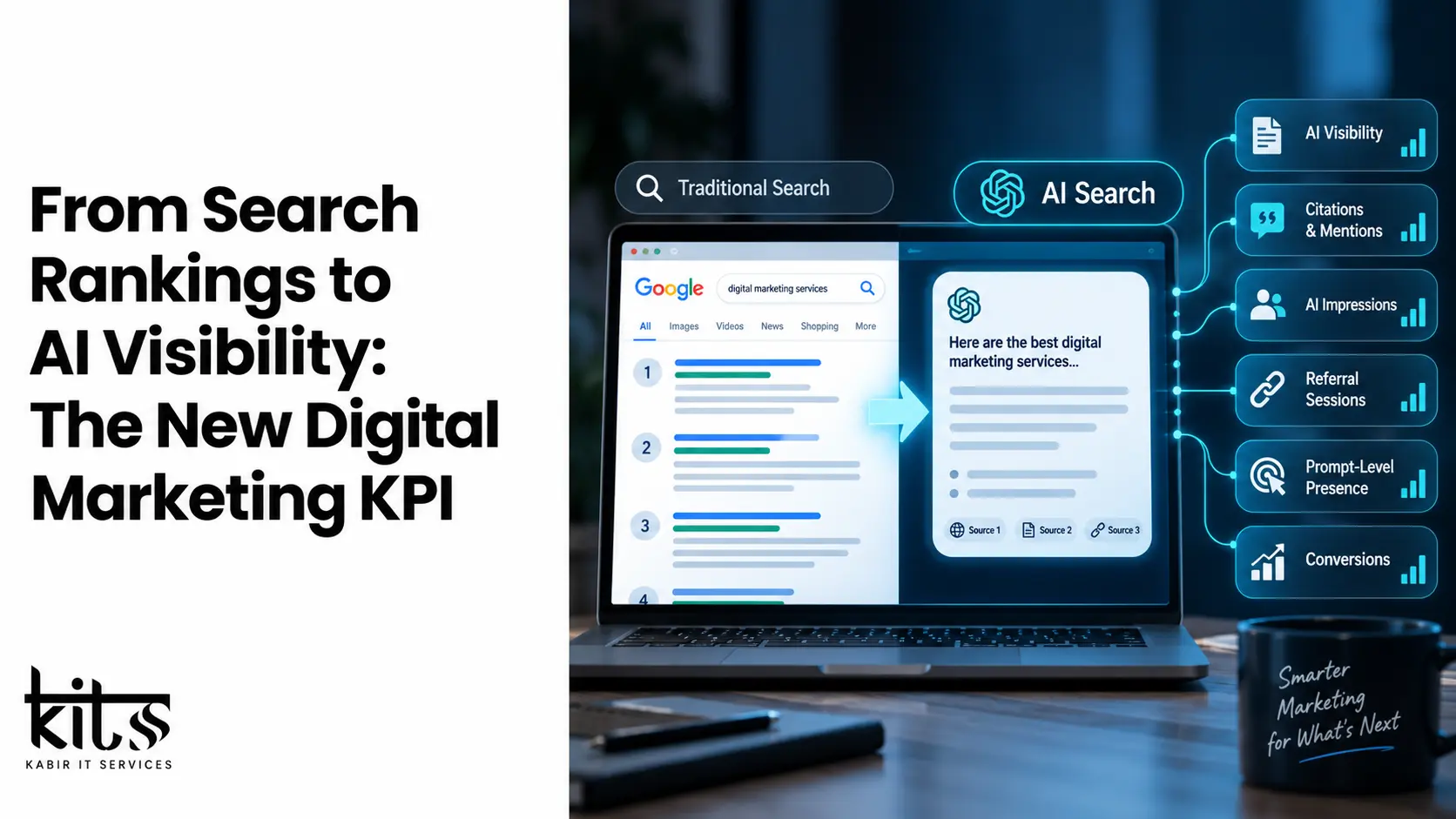
From Search Rankings to AI Visibility : The New Digital Marketing KPI
For years, digital marketers have used search rankings as one of the clearest indicators of SEO success.
A business would track keywords, monitor positions, measure organic traffic, and celebrate when important pages reached the first page of Google.
But search is changing.
People are increasingly using AI-powered tools and conversational search experiences to research products, compare services, find solutions, and understand complex topics. Instead of scanning ten blue links, users can ask an AI system a detailed question and receive a synthesized answer.
This creates a new question for marketers:
Is ranking on a search engine still enough to measure digital visibility?
The answer depends on what you are trying to measure.
Traditional rankings remain useful, but they are no longer the complete picture of how a brand can be discovered online. Businesses now need to consider another layer of visibility: AI visibility.
AI visibility refers to how frequently and accurately a business, product, service, or website appears within relevant AI-generated answers and conversational search experiences.
This doesn’t mean abandoning SEO.
It means expanding the way digital marketing performance is measured.
What Is AI Visibility?
AI visibility describes a brand’s presence in AI-powered discovery experiences.
A user might ask:
“What are some good ways for a small business to automate lead follow-ups?”
Instead of receiving a conventional list of webpages, the user may receive a conversational explanation containing tools, approaches, companies, or resources.
If your brand is consistently recognized in relevant contexts, that can represent a form of digital visibility that traditional keyword rankings don’t capture.
AI visibility can involve several factors:
- Brand mentions
- Website citations
- Inclusion in AI-generated answers
- Product or service references
- Entity recognition
- Topical authority
- Accuracy of brand information
- Presence across authoritative sources
The important distinction is that AI visibility is not simply another keyword ranking position.
It is about whether your brand is understood and represented within an answer.
Why Search Rankings Alone Are No Longer Enough
Keyword rankings have historically been useful because they provide a relatively straightforward measurement.
For example:
Keyword: AI automation services
Position: #4
Organic traffic: 1,200 visits/month
These metrics can tell you something about search performance.
But consider another user who asks an AI assistant:
“How can I automate customer follow-ups for my business?”
They may never see the traditional search results page.
That means a business could have strong rankings for several keywords while missing opportunities in AI-driven discovery.
Conversely, a business may have relatively modest rankings for some queries but still be recognized as a useful source within conversational search.
This doesn’t make rankings irrelevant.
It demonstrates that visibility is becoming more fragmented across different discovery interfaces.
The Evolution of Digital Marketing KPIs
Digital marketing KPIs have evolved repeatedly.
First: Traffic
Marketers focused heavily on:
How many people visited the website?
Then: Rankings
SEO became increasingly focused on:
Where does the website rank?
Then: Conversions
Businesses started asking:
How many visitors became leads or customers?
Now: Visibility Across Multiple Discovery Channels
The question is becoming broader:
Where and how is our brand being discovered?
This includes:
- Traditional search
- Maps
- Social platforms
- YouTube
- Marketplaces
- AI assistants
- Generative search
- Community platforms
- Industry websites
AI visibility is therefore better understood as part of a broader digital discovery strategy.
AI Visibility Is Different From Traditional Search Ranking
The two concepts measure different things.
| Traditional SEO | AI Visibility |
|---|---|
| Keyword position | Brand presence in AI answers |
| SERP visibility | Conversational discovery |
| Organic clicks | Mentions and citations |
| Search impressions | AI answer exposure |
| Backlinks | Entity and source authority |
| Keyword optimization | Topic and intent coverage |
| Search snippets | Contextual representation |
These metrics should not necessarily replace one another.
Instead, marketers can use them together.
What Factors Influence AI Visibility?
AI systems use complex processes to understand information. There is no universal formula that guarantees a brand will appear in an AI-generated answer.
However, several fundamentals can strengthen a website’s overall discoverability and information quality.
1. Topical Authority
A website that consistently publishes useful content around a specific subject can establish stronger topical relevance.
For example, a company focused on business automation could cover:
- AI automation
- CRM automation
- Lead automation
- Customer journey automation
- Workflow automation
- AI agents
- Marketing automation
- Business process automation
Instead of publishing unrelated content, the website builds a connected knowledge base.
2. Clear Business Information
AI systems need to understand entities.
Your website should make it obvious:
- Who you are
- What you do
- Who you serve
- Where you operate
- Which services you provide
- What makes your business different
A vague company description creates less useful context than a precise one.
3. High-Quality Content
AI visibility starts with useful information.
Content should answer real questions rather than exist solely to target keywords.
Instead of writing:
“AI automation is important for businesses.”
explain:
- Which business processes can be automated
- How automation works
- What tools can be integrated
- What risks businesses should consider
- How ROI can be measured
- Which processes should be automated first
Specific information is more useful to both users and search systems.
4. Entity Consistency
Your company’s name, services, descriptions, profiles, and other important information should remain consistent across legitimate online sources.
This helps establish a clearer digital identity.
For example, if one website describes your company as a digital marketing agency while another describes it primarily as a software development company, users—and automated systems—may have difficulty understanding the company’s core positioning.
5. Credible External References
A brand’s online presence shouldn’t depend entirely on its own website.
Relevant third-party references can provide additional context.
Examples include:
- Industry publications
- Professional directories
- Business websites
- Interviews
- Digital PR
- Partner websites
- Industry communities
- Relevant guest contributions
The objective should be relevance and credibility, not simply accumulating backlinks.
How to Measure AI Visibility
One of the biggest challenges is measurement.
Traditional SEO tools can provide keyword positions, impressions, clicks, and backlinks.
AI visibility is more complex.
A practical measurement framework can include several dimensions.
Brand Mention Rate
Track how often your company appears in relevant AI-generated responses during a defined set of test queries.
For example:
100 relevant prompts tested
Brand mentioned in 18 responses
This gives you a baseline.
However, the methodology must remain consistent because AI responses can vary.
Citation Rate
Measure how frequently your website is referenced or cited when your brand or topic appears.
For example:
AI responses containing your brand: 25
Responses linking to your website: 11
This can help distinguish simple recognition from source visibility.
Context Accuracy
A mention isn’t necessarily valuable if the AI system describes your company incorrectly.
Track whether the information is:
- Accurate
- Partially accurate
- Outdated
- Incorrect
This metric can be especially important for companies with multiple services.
Share of AI Mentions
For a defined group of queries, measure your brand’s presence relative to other brands.
For example, create a controlled test set around:
AI automation companies
Business process automation
Then periodically compare the presence of different entities.
This should be treated as an internal monitoring metric rather than a universal industry ranking.
Build an AI Visibility Measurement Framework
A useful framework can combine traditional and emerging metrics.
Layer 1: Search Visibility
Track:
- Keyword rankings
- Organic impressions
- Organic clicks
- CTR
- Organic traffic
Layer 2: Content Performance
Track:
- Content engagement
- Top-performing pages
- New organic landing pages
- Topic coverage
- Internal-link performance
Layer 3: Brand Authority
Track:
- Brand mentions
- Relevant backlinks
- Referring domains
- Digital PR coverage
- Third-party references
Layer 4: AI Visibility
Track:
- AI mentions
- AI citations
- Citation frequency
- Context accuracy
- Relevant prompt coverage
Layer 5: Business Outcomes
Ultimately, the most important metrics remain business outcomes:
- Qualified leads
- Sales opportunities
- Revenue
- Customer acquisition cost
- Conversion rate
- Customer lifetime value
AI visibility is valuable when it contributes to meaningful discovery and business outcomes.
How Businesses Can Improve AI Visibility
Create Topic Clusters
Choose important areas of expertise and build comprehensive content around them.
For example:
Main topic: AI Automation
Supporting content:
- What Is AI Automation?
- AI Automation Use Cases
- AI Automation for Small Businesses
- AI Lead Qualification
- AI Customer Support
- AI Customer Journey Automation
- AI Workflow Automation
- How to Measure AI Automation ROI
Connect these pages through internal links.
Answer Long-Tail Questions
AI search tends to involve conversational questions.
Create content around questions such as:
How can AI automate lead qualification?
What business processes should be automated first?
How much does AI automation cost?
What is the difference between AI automation and traditional automation?
These questions can become individual sections, FAQs, or complete articles.
Improve Your Service Pages
Your service pages should explain exactly what you provide.
A strong service page can include:
- Service definition
- Problems addressed
- Features
- Process
- Use cases
- Industries
- Benefits
- FAQs
- Case studies
- CTA
This provides a much stronger information source than a page containing only marketing claims.
Why Content Quality Matters More Than Content Volume
AI search changes the economics of content production.
Publishing 100 low-value articles may not create meaningful authority.
Ten genuinely useful resources can be more valuable if they comprehensively cover the questions your audience actually asks.
Before publishing an article, ask:
Does this page provide information that someone would genuinely find useful?
If the answer is no, adding more keywords probably won’t solve the problem.
The Role of Technical SEO
AI visibility doesn’t eliminate technical SEO.
Your website still needs a solid technical foundation.
Check:
- Crawlability
- Indexability
- Canonical URLs
- XML sitemap
- Internal linking
- Page speed
- Mobile usability
- HTTPS
- Structured data
- Broken links
- Duplicate content
A website cannot build strong content visibility if important information is difficult for search systems to access or understand.
How KITSS Fits Into the AI-Driven Digital Landscape
As businesses adapt to AI-powered discovery, they also need technology infrastructure capable of supporting modern digital workflows.
KITSS (Kabir IT Services) focuses on technology and automation solutions that can help businesses improve their digital operations.
KITSS provides a technology-focused platform covering areas such as automation and digital solutions.
For businesses, the opportunity is broader than simply trying to appear in an AI-generated answer.
AI can be incorporated into different parts of the customer journey, including:
Website → Lead Capture → Qualification → CRM → Follow-Up → Customer Communication
For example, a business could use automation to capture website enquiries, qualify leads, route prospects to the appropriate team, trigger follow-ups, and maintain customer communication.
This creates a connection between AI visibility and operational automation.
A business may attract a prospect through search or an AI-powered discovery experience, but the next challenge is turning that attention into an actual business opportunity.
That’s where digital marketing, automation, CRM systems, and customer journey optimization can work together.
Businesses interested in exploring these types of solutions can learn more about KITSS and its offerings at kitss.tech.
AI Visibility Should Not Become a Vanity Metric
There is a risk of turning AI visibility into another vanity metric.
A company could celebrate:
“Our brand appeared in 30 AI responses!”
But what happened next?
Did website traffic increase?
Did qualified leads increase?
Did sales opportunities increase?
Did customer acquisition improve?
The purpose of measuring AI visibility should be to understand whether new discovery channels are creating meaningful business value.
Therefore, AI visibility should be connected to downstream metrics whenever possible.
A Practical KPI Dashboard for 2026
A modern digital marketing dashboard could include:
SEO
- Organic clicks
- Impressions
- Rankings
- CTR
- Organic conversions
Content
- Organic landing pages
- Engagement
- Topic coverage
- Content-assisted conversions
Brand
- Brand searches
- Brand mentions
- Referring domains
- Digital PR coverage
AI
- AI mention rate
- AI citation rate
- Citation sources
- Context accuracy
- Prompt coverage
Business
- Qualified leads
- Conversion rate
- Revenue
- CAC
- Pipeline contribution
This gives marketers a much broader picture than a keyword ranking report alone.
Final Thoughts
The evolution from search rankings to AI visibility doesn’t mean traditional SEO is disappearing.
Instead, the definition of digital visibility is expanding.
People can discover a company through search engines, social platforms, communities, marketplaces, maps, and increasingly through AI-powered interfaces.
For marketers, this means the measurement framework needs to evolve as well.
Rankings tell you where you appear in traditional search.
AI visibility helps you understand whether your brand is being recognized in emerging AI-driven discovery experiences.
Neither metric tells the entire story.
The strongest strategy combines technical SEO, useful content, topical authority, structured information, brand building, AI visibility monitoring, and measurable business outcomes.
Companies that treat AI search as part of a broader digital ecosystem—rather than as a replacement for SEO—can build a stronger foundation for the changing search landscape.
For businesses looking to combine technology, automation, and digital growth strategies, KITSS offers technology and automation solutions worth exploring.
Frequently Asked Questions
What is AI visibility in digital marketing?
AI visibility refers to how a business, website, product, or service appears or is represented in AI-generated answers and AI-powered discovery experiences.
Is AI visibility replacing keyword rankings?
No. Keyword rankings remain useful for measuring traditional search performance. AI visibility adds another measurement layer for emerging AI-driven discovery.
How can I measure my brand’s AI visibility?
Create a consistent set of relevant prompts, test them periodically across the AI platforms you care about, and track brand mentions, website citations, context accuracy, and changes over time.
Does SEO help with AI visibility?
Many SEO fundamentals remain relevant, including crawlability, useful content, clear site architecture, authoritative information, internal linking, and structured data. However, there is no guaranteed SEO technique that ensures inclusion in a particular AI response.
Should businesses create separate content for AI search?
Usually, content should be created primarily to satisfy user intent. Clear answers, conversational language, strong topical coverage, and useful structure can make content valuable across both traditional and AI-powered search experiences.
What is the most important AI marketing KPI?
There is no single universal KPI. AI mentions or citations can measure visibility, but businesses should ultimately connect visibility metrics to qualified traffic, leads, conversions, pipeline, and revenue.