
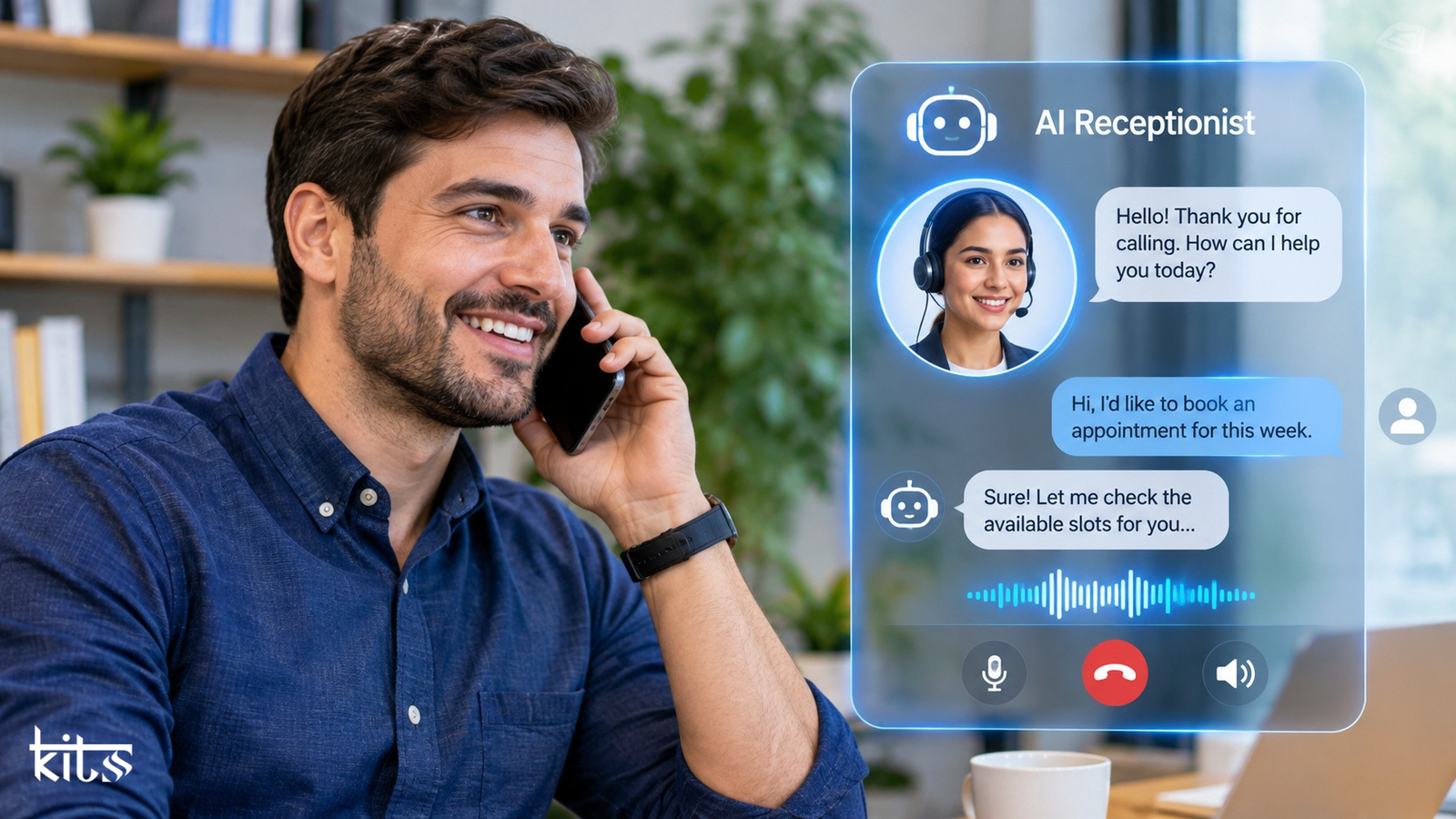
Your business might have a great website, a strong marketing strategy and a steady flow of enquiries. But what happens when a potential customer calls and nobody answers?
Every unanswered business call is a potential opportunity slipping away. A customer looking for a service, requesting a quote or trying to book an appointment rarely wants to keep calling until someone picks up. They may simply contact your competitor.
As businesses prepare for 2027, relying entirely on manual call handling, limited office hours and inconsistent follow-ups is becoming an increasingly difficult way to manage customer enquiries.
This is where an AI receptionist and AI voice agent can make a difference. These solutions can answer incoming calls, handle common questions, capture customer details, qualify leads, schedule appointments and support follow-ups without requiring someone to be available for every conversation.
If your business is still losing enquiries because calls go unanswered, it may be time to rethink how you manage customer communication.
Let’s explore how AI receptionists work, what they can do, which businesses need them and how to choose the right solution before entering 2027.
What Is an AI Receptionist?
An AI receptionist is a virtual assistant powered by artificial intelligence that answers business phone calls, interacts with customers, handles routine enquiries and performs tasks such as appointment scheduling and lead capture.
Unlike a traditional answering service that may simply take messages, an AI receptionist can understand what a caller needs and respond using information provided by the business.
For example, when someone calls a dental clinic to ask about appointment availability, an AI receptionist can answer basic questions, collect the caller’s details and help arrange an appointment according to the configured booking process.
An AI receptionist can typically:
Answer incoming calls 24/7.
Respond to frequently asked questions.
Capture customer names and contact details.
Understand customer requirements.
Qualify potential leads.
Schedule, confirm or manage appointments where integrations allow.
Route enquiries or arrange human callbacks.
Follow up with customers.
Maintain call records and conversation transcripts.
The goal is simple: make sure customers have a reliable way to reach your business, even when your team is busy or unavailable.
Why Your Business Cannot Afford to Keep Missing Calls in 2027
Think about how much effort goes into generating one qualified enquiry.
You invest in Google Ads, social media marketing, SEO, referrals and other marketing activities to bring potential customers to your business.
But when those customers finally call, an unanswered phone can break the entire process.
Consider these common situations:
A homeowner calls a plumbing company because they need urgent repairs, but the team is working at another location.
A potential property buyer calls an agent after seeing an advertisement, but nobody answers.
A patient calls a clinic to book an appointment outside regular working hours.
A customer calls an online store to ask about a product but cannot reach anyone.
A gym receives membership enquiries while its reception team is occupied.
These are not necessarily problems with your marketing. They are problems with how your business handles incoming opportunities.
Your marketing can generate the lead, but your customer communication process needs to capture it.
What happens when you miss a business call?
| Customer situation | What happens without an AI receptionist | What AI can help with |
|---|---|---|
| Customer calls after hours | The enquiry may go unanswered | Answers the call and captures details |
| Team is handling other customers | Caller waits or disconnects | Handles call overflow |
| Customer wants an appointment | Booking gets delayed | Collects details and supports scheduling |
| Customer requests pricing | Staff must respond manually | Answers approved pricing questions |
| New lead needs qualification | Sales team spends time gathering basic details | Asks relevant qualifying questions |
| Old lead needs follow-up | Enquiry may remain forgotten | Supports automated follow-up campaigns |
The longer you depend on manual processes for every call, the more opportunities you risk overlooking.
Need a Smarter Approach to Business Growth?
Let’s discuss your goals and find practical digital solutions that help your business move forward.
7 Signs Your Business Needs an AI Receptionist Before 2027
You do not necessarily need a large customer support team to run an efficient business. However, you do need a reliable way to handle customer enquiries.
Here are seven signs that your existing call-handling process needs an upgrade.
1. You Frequently Miss Calls During Business Hours
Your employees may be busy with meetings, customers, deliveries, appointments or daily operations.
Even when your business is open, that does not mean someone is always available to answer the phone.
An AI receptionist can answer incoming calls while your team focuses on its existing responsibilities.
2. Your Business Receives Enquiries After Hours
Potential customers do not always follow your office timings.
Someone might search for a service late at night, find your business online and immediately call to ask about availability.
Without an after-hours answering solution, you may lose the opportunity before your team returns to work.
An AI receptionist can answer these calls, collect relevant information and arrange the next step.
3. Your Team Repeats the Same Answers Every Day
How many times does your team answer questions about:
Business opening hours?
Service availability?
Pricing and packages?
Appointment timings?
Product information?
Business locations?
Booking procedures?
If your employees spend a considerable amount of time answering repetitive questions, an AI receptionist can handle many of these routine conversations using your approved business information.
4. Leads Are Not Followed Up Consistently
Capturing an enquiry is only the first step.
Potential customers may need additional information, a quotation, a demonstration or a reminder before making a decision.
An AI voice agent can support follow-up calls, appointment confirmations, enquiry reminders and lead reactivation campaigns.
5. Your Business Depends on One Person to Handle Calls
What happens when your receptionist is on leave, unavailable or already speaking with another customer?
If your entire communication process depends on one employee, you have a capacity problem.
AI can provide additional call-handling capacity without requiring another person to answer every routine enquiry.
6. Your Sales Team Spends Too Much Time Qualifying Leads
Not every enquiry is immediately ready to become a customer.
Sales representatives often need to ask basic questions about customer requirements, budget, location, service preferences and purchase timelines.
An AI agent can collect these details before the sales team follows up, helping representatives focus on more meaningful conversations.
7. You Have No Clear Visibility Into Missed Opportunities
If you cannot easily identify how many calls you receive, which enquiries turn into leads and which customers need follow-up, you are operating with limited visibility.
Call records, transcripts and lead information can help you understand where enquiries are coming from and how your team handles them.
What Can an AI Receptionist Actually Do for Your Business?
An AI receptionist is not just a tool for answering the phone. When configured correctly, it can support several stages of your customer communication process.
Here are some practical applications.
| AI receptionist feature | How it works | Business benefit |
|---|---|---|
| 24/7 call answering | Answers calls outside regular working hours | Fewer unanswered enquiries |
| Lead capture | Collects names, phone numbers and requirements | Better lead records |
| Lead qualification | Asks questions about customer needs and preferences | More organised sales enquiries |
| Appointment scheduling | Supports booking through connected calendars | Easier appointment management |
| FAQ handling | Answers approved business questions | Less repetitive work |
| Call routing | Directs enquiries according to configured rules | Better enquiry management |
| Missed-call recovery | Supports callbacks or follow-up messages | More opportunities to reconnect |
| Customer reminders | Makes appointment and service reminder calls | Better communication |
| Lead reactivation | Contacts eligible older enquiries | Helps revive dormant opportunities |
| Call reporting | Maintains call records and transcripts | Better visibility into customer interactions |
The exact capabilities depend on the AI platform, integrations, configuration and permissions available.
AI Receptionist vs Human Receptionist: Which Is Better for Your Business?
Does an AI receptionist mean you should replace your existing receptionist?
Not necessarily.
AI and human receptionists have different strengths. The right approach is to use automation for repetitive, predictable tasks while keeping employees available for situations that require personal attention, judgment or complex problem-solving.
| Comparison | AI receptionist | Human receptionist |
|---|---|---|
| Availability | Can operate 24/7 | Usually works scheduled shifts |
| Call handling | Can handle configured conversations at scale | Capacity depends on staff availability |
| Repetitive enquiries | Can automate routine answers | Requires repeated manual responses |
| Lead capture | Collects structured information | Can gather information through conversation |
| Appointment management | Can work with supported calendar integrations | Can manage bookings manually or through software |
| Complex situations | Requires escalation rules | Can use human judgment |
| Emotional understanding | Limited compared with human interaction | Better suited to sensitive conversations |
| Operating costs | Software and usage-based costs | Salary, training and staffing costs |
The smarter approach is not necessarily AI instead of people. It is AI working alongside people.
Let AI handle routine enquiries, initial qualification and reminders. Let your team focus on relationship building, complex customer needs and closing sales.
Which Businesses Should Use an AI Receptionist in 2027?
Almost every business that receives regular customer calls can explore AI receptionist technology. However, its usefulness depends on call volume, the type of enquiries and how much of the process can be automated safely.
Here are some examples across industries.
1. Real Estate Businesses
Real estate agents receive enquiries about property prices, locations, availability, configurations and site visits.
An AI receptionist can:
Answer property-related enquiries.
Ask about preferred locations and property types.
Collect budget and purchase timelines.
Qualify potential buyers.
Record site visit requests.
Arrange callbacks with sales representatives.
Example: A potential buyer calls about a three-bedroom apartment. The AI agent asks about the preferred location, budget and buying timeline, records the requirements and requests a callback from the sales team.
2. Healthcare Clinics and Dental Practices
Clinics receive regular calls about consultations, appointment availability, timings and general services.
An AI receptionist can:
Handle basic clinic enquiries.
Collect patient contact details.
Support appointment requests.
Confirm or remind patients about appointments.
Direct sensitive medical questions to qualified staff.
It should not independently diagnose patients or replace professional medical judgment.
3. Home Service Businesses
Plumbers, electricians, cleaning companies, HVAC contractors and repair businesses often receive calls while employees are working on-site.
An AI receptionist can:
Capture service requests.
Ask about the type of problem.
Collect property locations.
Identify urgent enquiries based on configured rules.
Arrange callbacks or service appointments.
This helps service providers spend less time managing incoming calls manually.
4. Gyms and Fitness Studios
Fitness businesses receive enquiries about memberships, trial sessions, class timings and renewal plans.
An AI voice agent can:
Answer membership questions.
Capture trial session enquiries.
Follow up with prospective members.
Send or make renewal reminders.
Contact eligible inactive members.
5. Salons, Spas and Beauty Businesses
Salon teams often cannot answer calls while serving customers.
An AI receptionist can:
Handle service and pricing enquiries.
Collect appointment preferences.
Support booking requests.
Confirm upcoming appointments.
Follow up with customers who have not returned.
6. E-commerce and Retail Businesses
Online stores and retail businesses receive enquiries about products, orders, delivery and returns.
AI can support:
Basic product information.
Order-related enquiries through connected systems.
Abandoned enquiry follow-ups.
Customer feedback collection.
Promotional and service reminder campaigns where permitted.
7. Education and Coaching Businesses
Training institutes, online educators and coaching centres receive enquiries from students and parents about courses, fees, admissions and schedules.
An AI receptionist can:
Answer common course questions.
Collect student details.
Qualify admission enquiries.
Schedule counselling calls.
Follow up with prospective students.
The common factor: These businesses depend on customer enquiries, and every enquiry deserves a reliable response process.
How to Choose the Best AI Receptionist for Your Business
Not every AI receptionist platform offers the same capabilities. Before investing in one, evaluate what your business actually needs.
Use this checklist to compare solutions.
| Feature to check | Why it matters |
|---|---|
| Natural voice conversations | Customers should be able to communicate comfortably |
| Multiple language support | Helps serve customers from different language backgrounds |
| 24/7 availability | Supports calls outside office hours |
| Custom business knowledge | Helps the AI answer questions using your information |
| Lead capture | Ensures enquiries are recorded |
| Lead qualification | Helps organise enquiries by customer requirements |
| Appointment booking | Reduces manual scheduling |
| CRM integration | Keeps customer information organised |
| Call recordings and transcripts | Helps review conversations and outcomes |
| Follow-up automation | Supports consistent communication |
| Human escalation | Provides a route for complex enquiries |
| Reporting | Helps measure call-handling performance |
Before choosing a provider, ask for a live demonstration using a realistic conversation from your industry.
Do not judge an AI receptionist only by how natural its voice sounds. Check whether it understands customer questions, follows your business rules, records information correctly and knows when to involve a human.
How to Set Up an AI Receptionist for Your Business
Getting started does not have to mean automating your entire customer support operation overnight.
Start with the most repetitive and time-consuming call-handling tasks.
Follow these steps:
Step 1: Identify Your Missed-Call Problems
Review your existing phone records and identify:
How many calls go unanswered?
When do most missed calls occur?
What questions do customers ask?
How many calls involve appointment requests?
How many enquiries require a sales callback?
Step 2: Define What Your AI Receptionist Should Do
Decide which responsibilities you want to automate first.
For example:
Answer incoming calls.
Provide business information.
Collect customer details.
Qualify leads.
Arrange appointment requests.
Create callback requests.
Step 3: Prepare Your Business Information
Your AI receptionist needs accurate information to answer customers.
Prepare:
Business name and introduction.
Products and services.
Working hours.
Locations and service areas.
Frequently asked questions.
Approved pricing information.
Booking policies.
Escalation and callback instructions.
Step 4: Connect Your Existing Tools
Where supported, integrate your AI receptionist with:
CRM software.
Appointment calendars.
Lead management systems.
Customer databases.
Messaging and notification platforms.
This helps prevent customer information from becoming scattered across multiple tools.
Step 5: Test Real Customer Conversations
Test different scenarios before making the system available to customers.
For example:
A customer asking about pricing.
A customer requesting an appointment.
A caller speaking in a different language.
An urgent service enquiry.
A customer asking to speak with a person.
A caller providing incomplete information.
Check how the AI responds and whether it correctly handles situations it cannot resolve.
Step 6: Monitor and Improve Performance
Review call outcomes regularly and improve scripts, responses and workflows based on actual customer interactions.
An AI receptionist should be continuously evaluated, not simply switched on and forgotten.
Meet Bol Bandhu: Voice AI That Answers, Books and Follows Up for Your Business
What if your business could answer customer calls, qualify enquiries and follow up with potential customers without depending on someone to manually handle every conversation?
This is where Bol Bandhu comes in.
Bol Bandhu is an AI voice agent platform designed to help businesses automate inbound and outbound customer calls. It can work as a virtual receptionist, appointment assistant, enquiry handler and lead follow-up agent.
Unlike a basic automated phone menu, Bol Bandhu is designed to hold natural conversations with customers in Hindi, English and Punjabi, making it particularly useful for businesses serving multilingual audiences.
Whether you operate a real estate agency, healthcare clinic, gym, educational institute, retail store, home service company or another customer-facing business, Bol Bandhu can be configured around your business requirements.
What Can Bol Bandhu Do for Your Business?
1. Answer Customer Calls 24/7
Bol Bandhu can answer incoming calls, greet customers, handle configured enquiries and collect relevant information, including outside regular business hours.
2. Capture and Qualify Leads
Instead of simply recording a missed enquiry, the AI agent can ask relevant questions about customer needs, budget, location, preferences and timelines.
3. Support Appointment Booking
It can handle appointment-related conversations, including booking requests, confirmations, rescheduling and cancellations according to the configured workflow.
4. Automate Follow-Up Calls
Have pending enquiries, quotations or appointments that need attention?
Bol Bandhu can support outbound follow-up campaigns to reconnect with leads and customers.
5. Reactivate Old and Inactive Leads
Businesses often have customer databases filled with enquiries that never converted.
Bol Bandhu can help contact eligible older enquiries, understand whether customers are still interested and record their responses.
6. Support Multiple Business Requirements
From appointment reminders and membership renewals to payment reminders, feedback collection and promotional campaigns, the platform supports several customer communication workflows.
7. Keep Track of Customer Conversations
Call records, recordings and transcripts provide visibility into conversations and captured lead information.
Why Consider Bol Bandhu Before 2027?
| Business challenge | How Bol Bandhu helps |
|---|---|
| Missed incoming calls | 24/7 AI call answering |
| Language barriers | Hindi, English and Punjabi conversations |
| Unqualified enquiries | Structured lead qualification |
| Repetitive customer questions | Automated enquiry handling |
| Pending follow-ups | Outbound follow-up campaigns |
| Old inactive leads | Lead reactivation campaigns |
| Appointment management | Booking and reminder workflows |
| Limited call visibility | Call logs, recordings and transcripts |
Bol Bandhu also offers a 14-day pilot with 200 calling minutes and one configured AI agent, allowing businesses to evaluate it through real conversations before committing to a longer-term plan. Check its website for current plan details and eligibility.
Your business does not need another complicated process. It needs a smarter way to handle the conversations that bring customers through the door.
Explore Bol Bandhu’s AI voice agent solutions and see how your business can start automating customer calls.
How Much Does an AI Receptionist Cost?
The cost of an AI receptionist depends on the provider, calling minutes, number of AI agents, integrations and features included in the package.
Some platforms offer monthly subscriptions, while others charge according to usage.
Before choosing a plan, consider:
Monthly call volume.
Average call duration.
Number of required AI agents.
Inbound and outbound calling requirements.
CRM and calendar integrations.
Call recording and reporting features.
Setup and customisation costs.
Additional usage charges.
A cheaper plan is not necessarily the better option if it cannot handle your actual customer communication requirements.
Compare the total operating cost against the value of the enquiries and appointments you can realistically recover.
How Do You Measure the ROI of an AI Receptionist?
Do not measure success simply by counting how many calls your AI receptionist answers.
The more important question is whether those conversations lead to better customer outcomes.
Track these metrics:
| Metric | What it tells you |
|---|---|
| Call answer rate | How many incoming calls are answered |
| Missed-call rate | How many calls remain unanswered |
| Lead capture rate | How many calls produce usable lead details |
| Qualified lead rate | How many captured enquiries meet your criteria |
| Appointment booking rate | How many calls result in bookings |
| Callback completion rate | How many requested callbacks are completed |
| Lead conversion rate | How many captured leads become customers |
| Cost per captured lead | How much you spend to capture an enquiry |
Simple AI Receptionist ROI Example
Suppose your business receives 300 calls per month.
For illustration, assume:
20% of calls are currently missed.
30% of those missed callers would have become qualified enquiries if successfully recovered.
20% of those qualified enquiries become paying customers.
Average revenue per new customer is $500.
| Calculation | Result |
|---|---|
| Total monthly calls | 300 |
| Missed calls (20%) | 60 |
| Potential qualified enquiries (30%) | 18 |
| Potential new customers (20%) | 3.6 |
| Potential monthly revenue | $1,800 |
This is an illustrative scenario, not a guaranteed result. Actual performance depends on customer behaviour, call quality, lead qualification, follow-up and conversion rates.
The exercise demonstrates why measuring missed calls and recovered opportunities matters before deciding whether an AI receptionist is worth the investment.
Is an AI Receptionist Better Than a Traditional Answering Service?
An AI receptionist and a traditional answering service both help businesses manage incoming calls, but their capabilities can differ.
A traditional answering service generally relies on human operators to answer calls, take messages and follow predefined instructions.
An AI receptionist can go further by handling configured conversations, collecting structured lead information, answering approved questions and connecting with supported business systems.
| Feature | Traditional answering service | AI receptionist |
|---|---|---|
| Call answering | Yes | Yes |
| After-hours coverage | Depends on service plan | Can operate 24/7 |
| Routine FAQs | Depends on operator instructions | Automated using business knowledge |
| Lead qualification | Manual | Can be automated |
| Appointment workflows | Depends on service | Supported through integrations |
| CRM data capture | Depends on service | Supported through integrations |
| Outbound follow-ups | Depends on provider | Available on platforms supporting campaigns |
| Human interaction | Yes | AI conversation with human escalation options |
The right solution depends on the complexity of your calls and how much automation your business needs.
What Are the Limitations of an AI Receptionist?
AI receptionists can improve call handling, but they are not a replacement for every customer interaction.
Businesses should understand their limitations before deployment.
Complex enquiries: Complicated situations may require a trained employee.
Sensitive conversations: Complaints, emergencies and sensitive matters need carefully defined escalation rules.
Incorrect information: An AI agent can provide inaccurate responses if its knowledge base or instructions are incomplete.
Integration limitations: Not every AI platform connects with every CRM, calendar or business application.
Language and accent variations: Real-world conversations should be tested across different accents, speaking speeds and background noise.
Customer preferences: Some callers will prefer speaking directly with a human.
A reliable setup should clearly define what the AI can answer, what information it can access and when it must arrange human assistance.
Businesses should also provide appropriate AI and call-recording disclosures, obtain any required consent and follow applicable privacy and telecommunications regulations. For example, the FCC’s guidance on AI-generated voices explains how US artificial or prerecorded voice rules can apply to AI-generated calls.
Final Thoughts: Don’t Let Missed Calls Become Your Business Strategy
As 2027 approaches, business growth will not depend only on how many leads you generate. It will also depend on how effectively you respond to, manage and convert those enquiries.
If your team is constantly occupied answering repetitive questions, customers struggle to reach you after hours or potential leads are waiting too long for callbacks, your business may need a smarter communication system.
An AI receptionist can help bridge that gap by answering calls, collecting customer information, qualifying enquiries and supporting follow-ups.
You do not have to automate everything at once. Start with missed calls, routine enquiries or appointment requests and expand as you see what works.
Your competitors are improving how they handle customer enquiries. Make sure your business is not still losing opportunities because nobody picked up the phone.
Explore Bol Bandhu to discover how voice AI can help your business answer, book and follow up more efficiently.
Ready to make your business work smarter? Start building a customer communication process that does not depend on someone being available every time the phone rings.